AI-Research and Articles - How AI-Art scales and Quality can be defined
Understanding the Formula Behind AI Art
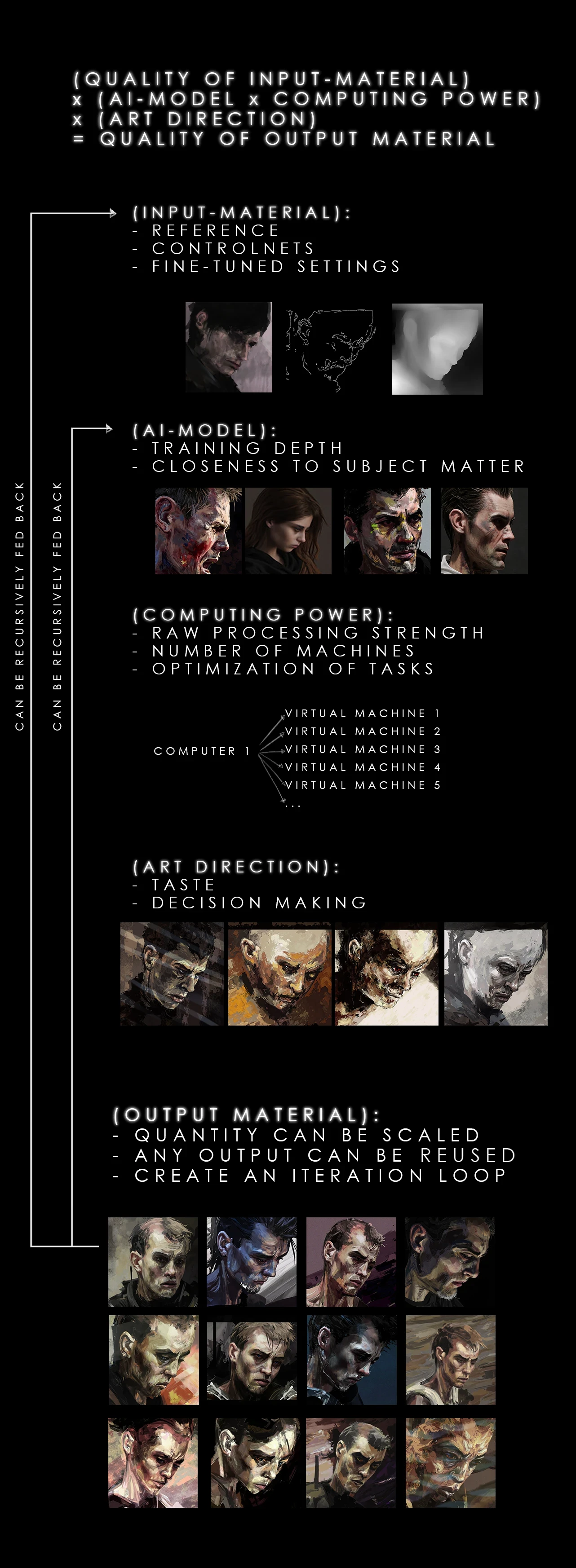
Despite the common belief that AI art is “random mush,” there is a very clear logic behind high-quality outputs. In fact, the results of any AI-art pipeline can be expressed as a simple formula:
(Quality of Input Material × (AI Model × Computing Power)) × (Art Direction) = Quality of Output
Each variable plays a distinct and critical role. When one is neglected, the result feels chaotic—not because AI is random, but because the setup is incomplete.
1. Art Direction as the Master Modifier
Art direction acts as a scaling factor, a multiplier that determines how effectively all other components perform. It can be expressed as a percentage between 0 and 1, representing how well the human vision aligns and guides the system.
Art Direction Value Description Result
0.2 Minimal understanding Chaos
0.5 Weak direction, weaker taste than the AI itself “AI Slop”
0.8 Strong conceptual clarity True “AI Art”
1.0 Perfect judgment and taste Indistinguishable from professional output
In normalized mathematical form, the relationship looks like this:
Q_out = (Q_in × (M × C)) × A_d
Where:
Q_out = Quality of Output
Q_in = Quality of Input Material
M = AI Model Quality / Suitability
C = Computing Power (scaling potential)
A_d = Art Direction coefficient (0–1 range)
A strong Art Direction Modifier (close to 1.0) amplifies the effectiveness of every other factor, while a weak one (0.2–0.5) drags the entire pipeline down, no matter how advanced the model or hardware.
Good art direction aligns the process. Poor direction reduces everything else to noise.
2. Why Computing Power Matters
Computing power defines scale. While one-click generations can produce test images, professional-quality workflows rely on horizontal scaling—deploying multiple virtual machines or GPUs in parallel.
AI art doesn’t scale additively (step by step). It scales multiplicatively.
With efficient delegation, production speed and output volume can grow exponentially.
3. The Importance of Input
The old saying “garbage in, garbage out” still applies.
Clean, well-prepared input—accurate ControlNet maps, isolated sketches, or structured references—translates directly to precision in the final image.
Messy input data forces the model to guess, and that guesswork shows.
4. Model Selection and Training
All AI models are not the same.
A general-purpose model produces broad, unspecialized results.
A task-specific model, trained on material aligned with your project, will consistently deliver sharper, more coherent outcomes.
Model choice determines whether your pipeline behaves like a sketch generator or a professional design tool.
5. The Irreplaceable Role of Art Direction
AI doesn’t remove the need for creative leadership—it amplifies it.
Every production still needs human judgment:
Is this good enough?
Does it fit the brief?
Should it be refined further?
These questions are not algorithmic. They’re aesthetic and experiential, developed through years of visual training. Art direction remains the one domain AI cannot replicate.
6. Iteration as a Strength
AI workflows are inherently recursive. Every output can become input for another cycle, allowing incremental improvement through refinement, inpainting, and compositional adjustments.
At an advanced level, artists can even retrain custom models from their own refined outputs, building a personalized creative engine.
Iteration isn’t a limitation—it’s the foundation of quality.
7. Structured Workflow: Big → Medium → Small
Professionals follow a clear progression:
Big: Quick, low-detail iterations to establish direction.
Medium: Focused refinement and visual clarity.
Small: Final inpainting, color correction, and compositional polish.
This layered approach replaces chaos with control and transforms experimentation into consistent results.
8. The Core Principle
AI art doesn’t scale additively—it scales multiplicatively.
Each element—input, model, compute, and direction—compounds with the others.
Understanding and applying that formula is what separates random generations from true AI-powered artistry.